


Take-apart construction toys turn “How does that work?” into hands-on play.
Your child can build a vehicle, test the moving parts, take it apart, and try again. That makes these sets more than one-and-done toys. They become small engineering projects, pretend-play props, and useful fine motor skills toys all in one.
But not every set fits every child.
Before you choose, compare the piece count, model options, tools, age range, storage, and overall play experience. The right set should feel challenging without becoming frustrating.
If you are building a screen-free routine, this is a natural next step after our guide to winning back screen-free fun.
Quick answer: which set fits your child?
- Choose the 7-in-1 set for younger builders who love construction vehicles, lights, sounds, and a complete play scene.
- Choose the 8-in-1 set for children who want more models and a structured STEM building challenge.
- Choose the 12-in-1 set for older or highly motivated builders who enjoy lots of parts, tools, and custom designs.
Here is the side-by-side view.
| Set | Pieces | Models | Best for | Standout features |
|---|---|---|---|---|
| 7-in-1 Take Apart Construction Toys with Accessories | Push and Go Toys for Boys and Girls | 84 | 7 | Children who enjoy vehicles and pretend play | Electric drill, playmat, 12 road accessories, lights and sounds |
| 100 Piece 8-in-1 DIY Learning Construction Toy | 100 | 8 | Builders ready for more variety | Step-by-step models, working mechanics, included tools |
| 12-in-1 Stem Kit Toy for Kids - 152 Piece Construction Building Set | 152 | 12 | Older or experienced builders | Heavy-duty components, rugged wheels, custom wrenches, storage tub |
1. Compare the number of pieces and models
A bigger box is not automatically a better choice.
More pieces can create more possibilities. They can also make the build harder to start, especially for a child who prefers simple choices.
Look for the balance between:
- Enough parts to encourage repeat play
- A clear first model
- Instructions your child can follow
- Extra pieces for custom builds
- A challenge that matches their current skills
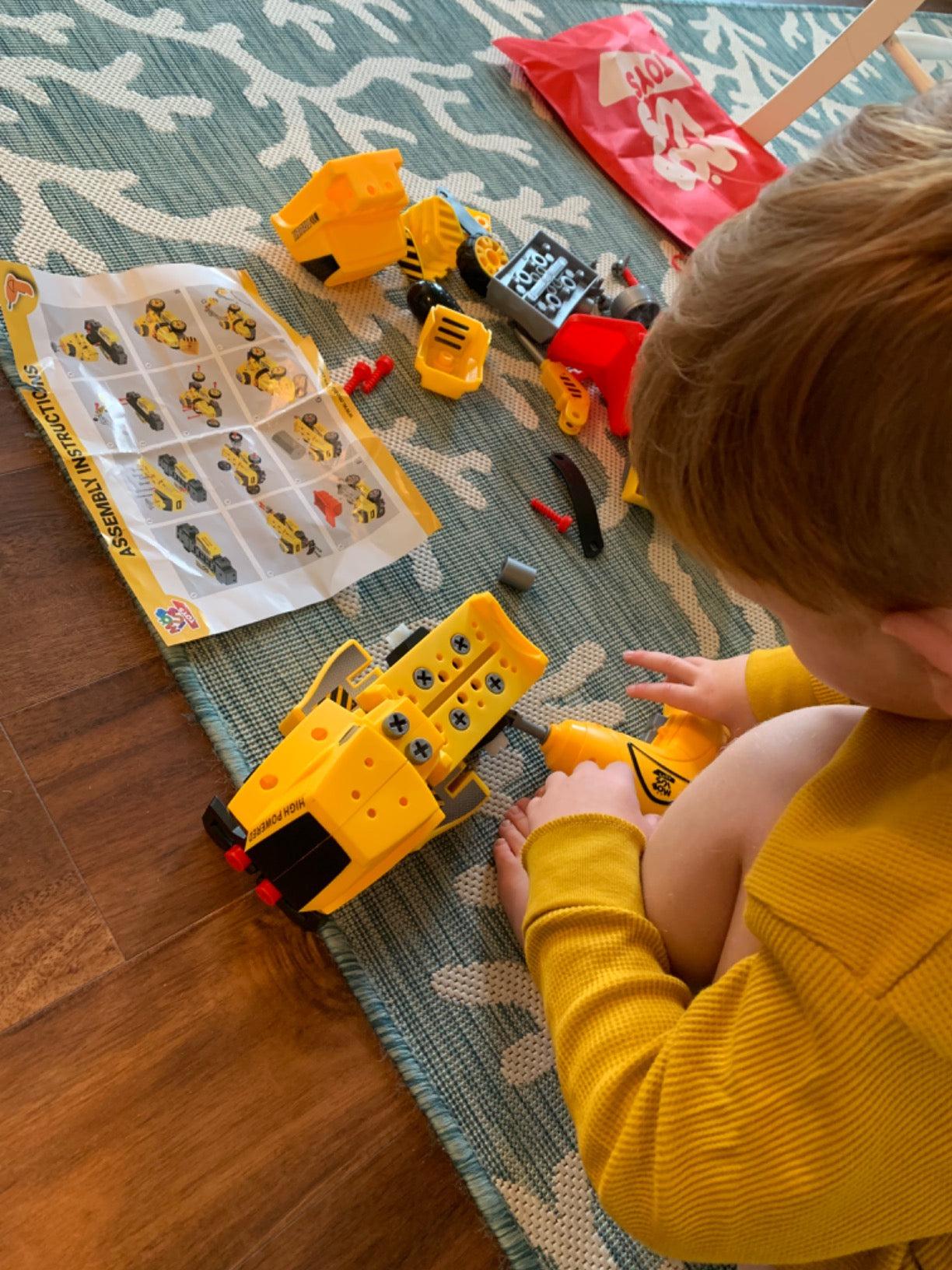
The 7-in-1 set includes 84 pieces and builds seven construction vehicles, including an excavator, jackhammer, steamroller, water tanker, bulldozer, dump truck, and rock saw. Your child builds one vehicle at a time, then takes it apart to create another.
Watch the same set build seven different trucks:
The 8-in-1 set moves up to 100 pieces and eight models. It is a good fit when your child enjoys following a plan but also wants to change the design afterward.
The 12-in-1 set includes 152 components and 12 models. It offers the most room for extended building, custom vehicles, and more complex projects.
Choose fewer models if your child gets overwhelmed by too many choices.
Choose more models if your child likes to keep changing projects and enjoys taking builds apart.
2. Look for tools that actually do something
A toy tool can be decorative, or it can become part of the play.
Working tools give your child a reason to slow down, line up parts, turn fasteners, and notice how pieces connect. Those repeated movements support hand strength, coordination, and early engineering thinking.
The 7-in-1 set includes a kid’s power drill, screwdriver, wrench, and screws. The drill works in forward and reverse, so your child can assemble and disassemble the vehicles.
That makes the tool part of the activity, not just an accessory in the box.
The 8-in-1 set includes the tools needed to build its models and focuses on working mechanics. It suits children who like the satisfaction of completing a model step by step.
The 12-in-1 set includes custom wrenches, nuts, bolts, structural parts, and rugged wheels. The hands-on process is slower and more involved, which can work well for a child who enjoys detail.
Check before buying:
- Is the tool functional?
- Does it require batteries?
- Is the tool manual or electric?
- Can your child grip it comfortably?
- Does the set include enough fasteners for repeated rebuilding?
For sound-sensitive children, start with manual tools or offer the electric drill only when your child is ready. You can also remove batteries between play sessions.
3. Check the plastic and construction quality
Take-apart toys need to handle repeated use.
Your child may tighten a screw too far, drop a vehicle, pull on a moving part, or rebuild the same model several times in one afternoon. Lightweight pieces that flex too much can make the experience frustrating.
Look for:
- Smooth edges
- Chunky parts that are easy to hold
- Fasteners that do not strip quickly
- Wheels that stay attached
- Pieces that fit together without excessive force
- Clear safety information from the manufacturer
The 8-in-1 product page describes bright, durable, non-toxic pieces and notes that the set is free from phthalates, lead, cadmium, and BPA.
The 12-in-1 set uses heavy-duty components, flexible plates, structural nuts and bolts, rugged wheels, and custom tools.
For any set, inspect the pieces when they arrive. If something is cracked, sharp, or difficult to use, stop and contact the retailer before continuing.
4. Match the age range to the child, not just the number on the box
Age labels provide a starting point. Your child’s actual play style matters too.
Younger builders
The 7-in-1 set is a practical choice for children who are ready for multi-step assembly and love construction vehicles. The playmat, road signs, and push-and-go movement help connect building with pretend play.
Plan to help with the first build. Hold a piece steady, point to the next step, or let your child finish the turn of the tool.
Growing builders
The 8-in-1 product page lists the set for ages 8–12. It works well for children who enjoy clear instructions, multiple construction models, and a little more challenge.
Use the age range as a guide, then consider attention span, hand strength, and comfort with small parts.
Experienced builders
The 12-in-1 set is the most involved option of the three. Its 152 pieces and 12 models give older children more room to troubleshoot, customize, and create their own vehicles.
The product page describes scalable difficulty, making it suitable for a range of builders when an adult is available to help as needed.
Always supervise play around small parts and follow the current safety guidance on the product page.

5. Do not overlook the playmat and accessories
A playmat changes how quickly a toy becomes a play invitation.
The 7-in-1 set includes a 31.5-by-27.5-inch playmat, 12 road accessories, signs, cones, barriers, trees, a fire hydrant, and a stop-and-go light.
Your child can build a vehicle, place the road pieces, and start a construction story without needing you to create the whole scene.
That extra context is useful for children who enjoy imaginative play but need a clear starting point.
The 8-in-1 and 12-in-1 sets focus more on building variety and model complexity. Add a tray, playmat, or small blocks if your child enjoys creating a full worksite around the vehicles.
Use a defined workspace. It helps keep parts visible, makes building feel more organized, and simplifies cleanup.
6. Think about storage and washing
Small pieces are easier to enjoy when they are easy to find.
The 7-in-1 set includes a storage bag. The 12-in-1 set includes a portable, easy-to-clean storage tub. For the 8-in-1 set, use a labeled container with separate sections for wheels, fasteners, tools, and vehicle pieces.
A simple cleanup routine can help:
- Put the mat or tray on the floor.
- Separate tools from building parts.
- Count or sort the fasteners.
- Store the instructions with the set.
- Keep batteries outside the container when possible.
For cleaning, wipe plastic parts with a slightly damp cloth and mild soap. Let everything dry fully before storage. Do not submerge electric tools, battery compartments, lights, or sound components.
7. Consider fine motor and sensory needs
Take-apart construction toys can be useful sensory toys for kids who enjoy predictable, hands-on actions. Turning a wrench, pushing a vehicle, sorting pieces, and clicking parts into place all provide tactile feedback.
They can also support:
- Hand-eye coordination
- Bilateral coordination
- Grip strength
- Wrist rotation
- Visual matching
- Problem-solving
- Spatial reasoning
- Patience through repetition
For autistic children and children with sensory needs, look for a set that matches their preferences.
Choose predictable steps. Clear instructions and repeated screw types can make the build easier to understand.
Watch the sound level. Lights and sounds may be exciting for one child and overwhelming for another. Use the drill only when your child wants it.
Offer a defined workspace. A playmat or tray can reduce visual clutter and keep parts from spreading across the room.
Let repetition count. Rebuilding the same vehicle is not “doing it wrong.” Repetition may be the part your child finds most satisfying.
These toys are not a treatment, and every child responds differently. Follow your child’s cues. Stop when the activity becomes stressful, and return to it another day.
The final choice
Choose the 7-in-1 set when you want a complete construction scene with a drill, playmat, road accessories, lights, sounds, and seven take-apart construction vehicles.
Choose the 8-in-1 set when your child wants more models and enjoys a structured STEM challenge.
Choose the 12-in-1 set when your child is ready for the largest piece count, the most models, and more room for custom building.
The best set is the one your child will return to.
Build it. Take it apart. Try a new design. That is where the learning happens.
Choose a set. Clear a workspace. Let them figure it out.